

Peak Heatwave Rewilding at Downicary
A scorching, bone-dry summer isn't exactly rewilding's dream weather. Yet at Downicary, nature seems determined to prove it doesn't need perfect conditions, just a chance.
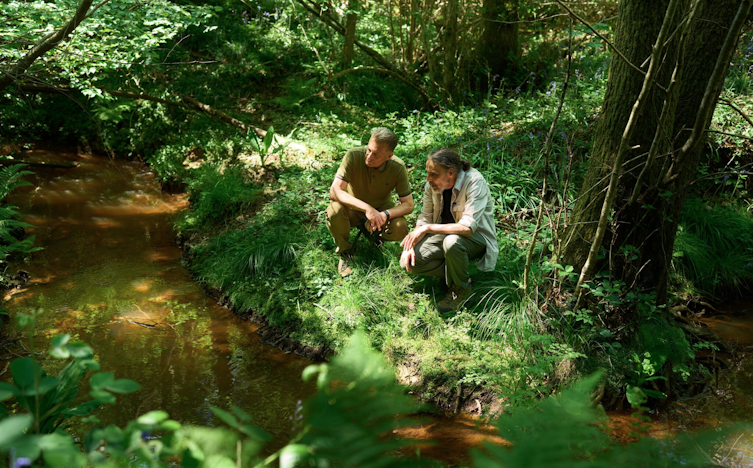
Across the two rewilding sites in Devon and East Sussex, a team of specialists, ecologists and conservation partners have been replanting, reshaping and reviving land for wildlife. A year on, Ecotalk's Chief Ecologist Chris Packham has been out at both sites marking the milestone, and there's plenty to show for the last twelve months.
A flat field became a wetland.
A year ago, Downicary in Devon was, in Chris's words, a plain, flat, green field. Today it's unrecognisable. A system of ponds and wetland areas has been dug in, filling with water over winter and drawing wildfowl and waders. As the water level has dropped back in summer, dragonflies, damselflies and important marshland plants have moved in to take their place. The grass itself has changed too, with patches left long and in flower.
Tree planting has been just as busy. Black poplar is going in alongside alder, which is thriving, and aspen, planted as something of an experiment that's paying off. Close monitoring of the site has already turned up otters, kingfishers and beavers along the river, on top of everything settling into the new ponds and grassland.
3,500 trees, one muddy afternoon
In February, local primary school children joined Chris at Downicary to help plant part of a much bigger tree planting programme: 3,500 trees and shrubs, sourced from the Woodland Trust, going into the ground across a 55-acre site.
The planting plan spans three habitat types. Wet woodland and riparian planting, willow, aspen and alder set densely to extend and connect riverside woodland. Open woodland planting, oak, birch and rowan in the drier areas to create wood pasture and expand existing wooded patches. And bund planting, flowering shrubs including blackthorn, hawthorn, spindle and dog rose to reduce bank erosion and boost forage for birds and insects.
Ecotalk founder Dale Vince said the day captured what the Devon site is all about: “With the help of the Woodland Trust we've got kids planting thousands of trees, oaks, willows, aspens, all under the expert guidance of Britain's leading ecologist Chris Packham. We're bringing nature back to life. It's practical, hopeful, and it's making a difference. Ecotalk customers are funding this simply by making calls and sending texts.”
Chris added: “Planting trees works on many levels. Obviously, biodiversity, carbon capture, flood mitigation, but also crucially in terms of personal empowerment. So when young people plant trees it instigates not only a clear connection with nature, but also a significant investment in a future. Planting trees is all about hope.”
3,000 tonnes of earth. Zero boring fields left.
Over at Bowyers Wood in East Sussex, the fields are no longer flat and grassy either. They're now full of plants as the land begins to regenerate, and the team has dug a scrape as part of that transformation. We also ran a BioBlitz on site during the heatwave in June, with Ecotalkers turning out bright and early on a Saturday morning to survey invertebrates, plants and the wildlife living in the stream.
Across the sites, the team has shifted 3,000 tonnes of earth to create new habitats for invertebrates, reptiles and small mammals. That work has shaped mounds and sheltering spaces: basking spots for common lizards and grass snakes, perches for dragonflies and butterflies, burrows for small mammals, and nesting banks for birds like sand martins. It's the kind of structural complexity a healthy ecosystem needs to thrive.
18 species of bat in the UK. Sussex has nearly all of them.
Bat surveys are also underway at Bowyers Wood. Static acoustic detectors, left out on site for up to two weeks at a time, have already picked up several species, including common and soprano pipistrelle, Daubenton's, Natterer's, and brown long-eared bats, alongside the barbastelle, a rarer species that favours the woodland's rides.
A night of trapping with harp traps, mist nets and acoustic lures, carried out under licence with bat expert Professor Fiona Matthews, brought in brown long-eared, pipistrelle and noctule bats. Each was weighed, measured and checked under UV light for damage invisible to the naked eye. Bats are slow breeders, some produce just one pup a year, and can live for decades (the oldest UK bat on record reached 41), which makes them a valuable early signal for the health of a woodland. This baseline data will help track how the site changes as the beavers make it wetter, and which species benefit most.

Who's a-hoo? The owls, that's who
Four raptor poles and six owl boxes have gone up, giving birds of prey more places to hunt and nest. Two of the three tawny owl boxes were occupied in their very first breeding season, and both pairs laid clutches of five eggs. Nine tawny owl chicks have since been ringed as part of the team's ongoing monitoring of the local breeding population.
Early signs are encouraging too: more reptile sightings, rising water levels, and the beavers' first lodge, all recorded as part of the developing biodiversity picture.
Eighteen trees, one very rare comeback
In East Sussex, eighteen black poplars have been planted within the beaver enclosure and protected while they establish. The team chose a mix of male and female trees to support future seed production and genetic diversity. Black poplar is one of the UK's rarest native trees, historically found in wet woodland and floodplain habitats, exactly the kind of landscape this site is becoming.
37 species just turned up. No invitation needed.
Baseline breeding bird surveys in East Sussex have recorded 37 species across the woodland and surrounding habitats, a strong early indicator of the site's ecological value. The mix of mature woodland and tall conifers is already supporting several species of conservation concern, including lesser redpoll, lesser spotted woodpecker, marsh tit, mistle thrush, skylark and spotted flycatcher.
Beavers are back. First time in 400 years.
We saved the best for last, the news that got us going viral. A fence went up (a condition of the licence issued by Natural England until 2030), and a family of beavers moved down from Scotland into their new East Sussex home, the first beavers here in 400 years. They settled in straight away, and we've had cracking daylight views of them ever since. The family has since grown, with a young beaver kit born in Bowyers Wood. The team, which includes experts from the Beaver Trust, are monitoring closely how they behave and settle in, and further down the line, when the time is right, some animals may be moved out beyond the enclosure.
Year one, done. Nature's just getting warmed up.
None of this happens overnight. A single breeding season of owls, a first beaver lodge, eighteen young poplars, these are early chapters in a much longer story of habitat recovery across both sites. However, they're proof the sites are responding, and that's exactly what we hoped to see one year on.
We'll keep sharing what we find as the monitoring continues!