

Peak Heatwave Rewilding at Downicary
A scorching, bone-dry summer isn't exactly rewilding's dream weather. Yet at Downicary, nature seems determined to prove it doesn't need perfect conditions, just a chance.
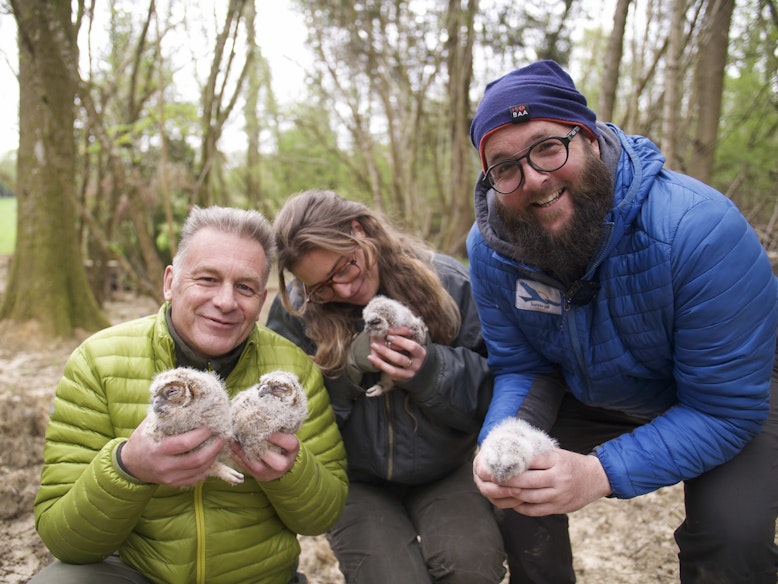
This season has transformed Bowyers Wood. Chiffchaffs are calling from almost every corner of the woodland, blackcaps fill the air with their rich, melodic song, and the unmistakable drumming of great spotted woodpeckers echoes through the trees. It's one of those mornings when every part of the woodland seems alive, making it the perfect time to return to the tawny owl nest boxes that Chris Packham and licensed bird ringer Jimmy Hill inspected just a few weeks earlier.
On that first visit, the team discovered five tawny owl eggs in one nest box and a female sitting tight in another. It was an encouraging sign that the nest boxes installed at Bowyers Wood were already proving their worth, but there was still an anxious wait ahead. Would the eggs hatch successfully? Would enough food be available for the adults to rear their chicks? More importantly, would any young owls survive long enough to reach the stage where they could be safely ringed?
Today, those questions are about to be answered.
Jimmy is licensed by the British Trust for Ornithology (BTO) to ring birds, and every visit is carefully timed. Tawny owl chicks can only be ringed during a relatively short window in their development. Their legs must be fully grown so the lightweight identification rings fit correctly, but the chicks also need to remain in the nest. Leave it too late and they'll already have reached the next stage of their lives, leaving the nest box to climb among the surrounding branches before they're capable of proper flight – a behaviour known as branching. With timing so critical, there is little room for error.
Before approaching the first nest box, Chris Packham slips on a pair of safety glasses. It raises a smile, but there's a serious reason behind the precaution. Female tawny owls have a reputation for fiercely defending their young, particularly once the chicks are nearing the branching stage. Chris recalls the famous story of pioneering wildlife photographer Eric Hosking, who lost the sight in one eye after being struck by a tawny owl while photographing a nest many decades ago. Although encounters like that are rare, it's a reminder that these familiar woodland birds are dedicated parents when their young are involved.
With everything prepared, Jimmy climbs steadily towards the first nest box while Chris waits below.
Four Chicks, One Rat, Zero Regrets
As the lid is carefully lifted, the tension disappears almost instantly.
"Four chicks."
It's wonderful news. The five eggs discovered on the previous visit have become four healthy tawny owl chicks, with just one addled egg remaining in the corner of the box. Nestled alongside them is another surprise: a large brown rat, stored by the adult owls ready for the next feeding session. It might seem astonishing that a tawny owl could overpower prey of that size, but these adaptable woodland predators are far more formidable than their soft appearance suggests. Wood mice and voles make up much of their diet, but they're perfectly capable of taking larger prey whenever the opportunity arises.
One by one, the chicks are gently lowered to the ground in a soft bag before being transferred to a shaded working area nearby. The entire process is designed to be as quick and calm as possible, minimising disturbance before the youngsters are safely returned to the nest. As each chick emerges, they're already showing flashes of the character they'll need later in life. Several greet their visitors with sharp bursts of beak-clicking, a defensive behaviour used to warn off potential threats. For birds that are only a few weeks old, they're already surprisingly confident.
Lined up together, another detail immediately catches the eye. Although they all belong to the same brood, they're noticeably different sizes. The largest chick is considerably more developed than the smallest, with darker feathers already beginning to push through the fluffy down. It's a perfectly normal sight for anyone monitoring tawny owl nests and is explained by a fascinating breeding strategy known as asynchronous hatching.
Rather than waiting until every egg has been laid before beginning incubation, female tawny owls start warming the eggs almost immediately. As a result, the first chick hatches several days before the last, giving it a head start in development. If food becomes scarce later in the season, the older, stronger chicks stand the best chance of surviving. It may seem harsh, but it's one of nature's ways of ensuring at least some young survive difficult years. This year, however, every chick appears healthy, alert and well fed – a strong indication that food has been plentiful throughout the breeding season.

Tiny Rings, Big Data
With the chicks safely on the ground, Jimmy begins the careful process of fitting each one with a lightweight aluminium ring issued by the British Trust for Ornithology. At first glance, the rings look incredibly simple, yet each carries a unique identification number that will stay with that owl for the rest of its life. That tiny sequence of numbers transforms an anonymous bird into an individual whose story can continue to be told, whether it's encountered months or even decades from now.
Every ring number is recorded alongside the chick's weight and other measurements before being submitted to the BTO's national ringing database. If one of these tawny owls is found nesting elsewhere, recovered after an accident or caught again by another licensed ringer, researchers will be able to trace exactly where it hatched and build a picture of its life. Thousands of records collected over many years have already transformed our understanding of Britain's tawny owls, revealing that, unlike many birds, they rarely travel great distances. Most establish territories only a few kilometres from where they first leave the nest, meaning some of the chicks being ringed today could one day become breeding adults in Bowyers Wood itself.
As each youngster is weighed, it's immediately obvious how quickly they're growing. The largest chick tips the scales at close to 400 grams, not far short of an adult bird, while its younger siblings are only slightly lighter. It's a reminder of just how much energy is invested in raising a brood of tawny owls. Every night, the adult birds must hunt enough prey to satisfy four rapidly growing appetites, returning repeatedly with mice, voles, shrews and, occasionally, larger mammals like the rat found in the nest earlier that morning.
The chicks themselves reveal another remarkable stage of development. Along their wings, new feathers are emerging inside protective waxy sheaths known as pin feathers. These pale coverings gradually flake away as the feathers reach their full length, eventually revealing the beautifully patterned plumage that will camouflage the young owls among the bark and branches of the woodland. Within only a few weeks, these fluffy bundles of down will have been transformed into agile young hunters preparing to leave the nest behind.
What makes the condition of these chicks even more encouraging is what it says about the wider health of Bowyers Wood. Successful tawny owl breeding depends almost entirely on food supply, and everything Jimmy has seen this spring suggests the woodland is experiencing an exceptional year for small mammals. Several unused owl boxes have even been found containing cached prey – wood mice, voles and other rodents stored by the adult owls for later. It's exactly the kind of abundance that allows female tawny owls to lay larger clutches and successfully rear more young.
Nature is remarkably economical. If food is scarce, tawny owls simply breed less successfully, often laying only two or three eggs. But when prey is plentiful, they seize the opportunity. Judging by the four thriving chicks sitting in front of Chris and Jimmy, this is one of those good years.
Plot Twist: There Are FIVE
With the first brood safely weighed, ringed and returned to the nest box, Chris and Jimmy make their way to the second owl box. Their last visit had revealed only a sitting female, making it impossible to know how many eggs she was incubating. Chris predicts there might be four chicks inside, but even he admits it's an optimistic guess.
As Jimmy peers into the box, his expression says everything before he speaks.
There aren't four chicks.
There are five.
For a moment, the team are genuinely taken aback. Despite monitoring well over a hundred active tawny owl nest sites during his career, Jimmy has never ringed a brood of five tawny owl chicks before. It's an extraordinary discovery and further evidence that this has been an exceptional breeding season at Bowyers Wood.
One by one, the chicks are carefully lowered from the nest box before the same process begins again. Each youngster is fitted with a BTO ring, weighed, recorded and checked over before being safely returned to its home. Although these chicks are around a week younger than those in the first nest, they're all in excellent condition, with healthy weights and developing feathers that show they're growing exactly as they should.
The five siblings are remarkably similar in size, suggesting that every chick has had access to plenty of food. That's significant because tawny owls don't breed successfully by chance. Every egg laid represents a considerable investment for the female, and she will only produce larger clutches if conditions are right. The more prey the adults can find, the greater the chance of successfully raising a large family.
Everything Jimmy has observed this spring points towards one conclusion: there is an abundance of small mammals in the woodland. It's something he's noticed not only while checking the tawny owl boxes, but through his work monitoring other birds of prey as well. Some of the barn owls he follows have already begun hatching chicks almost a month earlier than usual, another strong indication that voles, mice and other small mammals have enjoyed an excellent year.
Healthy predators are often one of the clearest signs of a healthy ecosystem. The nine tawny owl chicks ringed today are more than simply an encouraging statistic—they're evidence that the wider woodland is functioning exactly as it should.
A Box. A Bird. A Breakthrough.
The success of today's visit also highlights the value of something surprisingly simple: a well-designed nest box in the right place.
Tawny owls naturally nest inside cavities in mature trees, but suitable holes have become increasingly scarce as ancient trees disappear from many landscapes. Although Bowyers Wood contains plenty of wonderful habitat, genuinely large natural nesting cavities are still in short supply. Without these purpose-built owl boxes, many breeding pairs would be forced to search elsewhere or make do with old crow or magpie nests, which offer far less protection from predators and bad weather.
The fact that two of the three tawny owl nest boxes installed at Bowyers Wood were occupied almost immediately suggests they were meeting a genuine need. Sometimes conservation isn't about large-scale engineering projects or expensive interventions. Sometimes it simply means understanding what wildlife needs and providing it.
The nest boxes are already becoming much more than places to raise chicks. Throughout the year they provide opportunities to monitor breeding success, understand population trends and collect valuable scientific data. Later in the season, Chris and Jimmy hope to return once again to examine the owl pellets left behind by the adults. Those pellets contain the tiny bones and fur of prey animals, offering another fascinating insight into what tawny owls have been eating and how healthy the woodland food web really is.
Each visit adds another chapter to the story of Bowyers Wood, helping build a clearer picture of how wildlife responds when habitats are allowed to recover and flourish.
Spotted a Baby Owl? Step Away.
As these youngsters continue to grow, they'll soon reach one of the most unusual stages in a tawny owl's life.
Unlike many birds, tawny owls don't simply fly from the nest when they're fully feathered. Instead, they leave the safety of the nest box before they can properly fly, climbing onto nearby branches where they continue calling to their parents for food. This stage, known as branching, allows them to strengthen their wings and build confidence before eventually taking to the air.
It's also the time when members of the public are most likely to encounter them.
Every year, well-meaning people discover fluffy young tawny owls sitting on low branches—or sometimes even on the woodland floor—and assume they've been abandoned or fallen from the nest. In reality, this behaviour is completely normal. The adult owls are usually watching from nearby and will continue feeding and protecting their youngsters, even if they aren't immediately visible.
Unless a chick is clearly injured or in immediate danger, the best thing you can do is leave it where it is. If it's sitting somewhere vulnerable, such as a path or road, gently moving it onto a nearby branch is often all that's needed. Taking a healthy branching owl into captivity, however well intentioned, usually reduces its chances of returning successfully to the wild.
Understanding that behaviour can make all the difference, allowing young owls to complete this important stage of their development naturally.
Nine Tiny Reasons to Celebrate
By the time the final chick disappears back into its nest box, the morning's work is complete.
Nine tawny owl chicks have been carefully weighed, fitted with BTO rings and safely returned to their nests. Every measurement has been recorded, every ring number logged and every youngster handled with the care that licensed bird ringing demands.
For Chris and Jimmy, it's been a memorable day, but the significance reaches far beyond the excitement of finding so many fluffy chicks. Together, these two successful broods tell a much bigger story about Bowyers Wood. They speak of abundant prey, suitable nesting sites and a woodland that is providing the conditions wildlife needs to thrive.
Perhaps most importantly, they remind us that conservation is often measured in small victories. A nest box installed years earlier. Careful monitoring by dedicated volunteers. Scientific records submitted to the British Trust for Ornithology. On their own, each may seem modest. Together, they build the knowledge and understanding needed to protect species like the tawny owl for generations to come.
Watching the last youngster settle back into the darkness of its nest box, it's impossible not to feel optimistic. Just weeks ago, these were little more than eggs tucked safely beneath a watchful female. Today, they're nine healthy tawny owl chicks, each beginning its own journey through the woodland.
For Chris, there's only one way to describe them.
"Some people would say they were cute. I mean, some people would say they're very cute indeed. I'm one of those people."
We couldn't agree more.