

Dam Good News
During one of the driest summers on record, the beavers of Bowyers Wood did exactly what they evolved to do.
A scorching, bone-dry summer isn't exactly rewilding's dream weather. Yet at Downicary, nature seems determined to prove it doesn't need perfect conditions, just a chance. Chris Packham joined Tay in Devon to see how the landscape is developing.
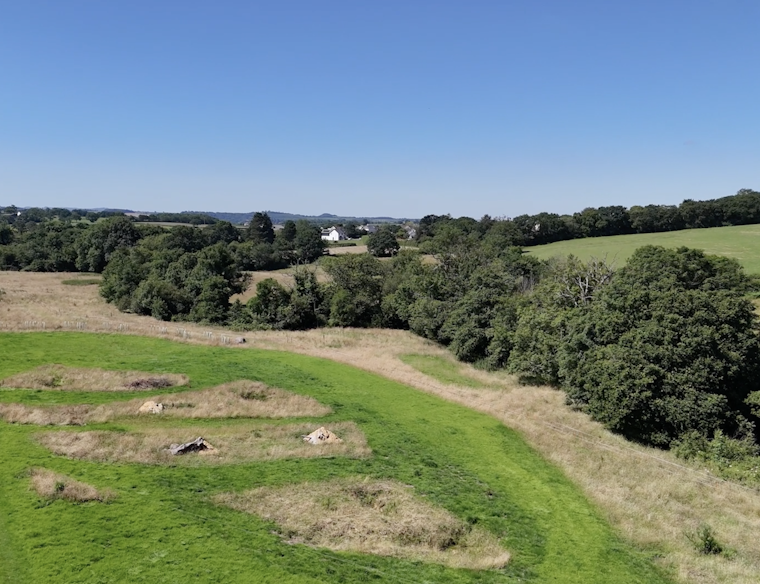
The findings? Thriving young trees, an emerging wetland, long grass and wildflowers, and wildlife already moving in to make the most of it. What was once a flat, closely cropped field is starting to look like something else entirely.
The trees are winning against the heat
First things first: the trees are doing brilliantly. Despite the heat and the lack of rain, most are still green and growing, with some of the smaller saplings already bursting out of their protective tubes. Planting at the right time of year gave them the best possible start, and the early survival rate is looking strong.
Willow is proving especially tough. Even trees that looked like they'd suffered dieback are pushing out new growth, while black poplars have shot up since the last visit. Aspen and other young trees are starting to establish too, slowly adding shape and structure to the landscape. It's early days. But the bones of a much richer habitat are already visible.

A patchwork with a purpose
Look across the site and you'll spot long grass sitting right next to freshly cut patches. That contrast isn't an accident, it's a strategy.
The soil at Downicary is still fairly nutrient-rich, which sounds like good news until you realise it means the grass grows fast and thick enough to crowd out everything else. Wildflowers don't stand a chance against that kind of competition.
The fix is surprisingly low-tech: cut the grass, then take the cuttings away. Leave them to rot down and you're just feeding the soil more of what it doesn't need. Remove them, and the nutrients gradually drain out of the system, giving wildflowers room to compete.
Not every patch gets the cut, though. Leaving long grass standing gives insects, birds and other animals somewhere to feed and shelter, with seed heads providing a ready food source through the season. The result is a landscape stitched together from different habitats, each doing its own job.
From a lake to a handful of puddles
The water tells its own story of extremes. After an exceptionally wet winter and spring, Downicary held enough water to pass for a small lake. Fast forward through a dry summer, and that lake is now a scattering of puddles. Smaller doesn't mean useless. There's still water in the landscape, and wetland plants are getting on with the job regardless: rushes and marsh vegetation are establishing well, some of it transplanted in from elsewhere on site.
There's also a plan taking shape to divert a trickle from a nearby culvert, keeping the ponds topped up rather than letting that water run straight off into the river.The wetland was always designed as an experiment, something to watch, learn from and adjust. That's rewilding in a nutshell: pay attention, then adapt.
More structure, more life
The biggest change at Downicary is the landscape itself. Where there was once a fairly uniform field of short, sheep-grazed turf, there's now real texture: young trees, long grass, wetland pockets, wildflowers, and patches of vegetation all at different stages of growth.
Wildlife has noticed. Butterflies and dragonflies are already using the site, and a buzzard has been spotted hunting overhead. The long grass matters most for small mammals. Voles had almost nowhere to hide in the old, closely grazed field. Now, as the grass thickens and grows taller, it's creating exactly the kind of cover they need to feed and shelter. Small mammals tend to draw predators before long. In time, the hope is that kestrels and barn owls will start using the site too. Building that kind of structure takes years, not months. But the direction of travel couldn't be clearer: Downicary is getting wilder.
What the camera trap caught
The real surprise came when Chris and Tay checked the camera trap footage. First up: a kingfisher. Not just a fleeting cameo, either. The footage shows the bird returning again and again to a small pool left behind as the stream dried out, clearly making the most of the fish still trapped there.
Foxes, herons and roe deer all made appearances too, along with a steady stream of mallards that seem to have adopted the area as a regular route, mallard chicks included. Then, just as patience was wearing thin, an otter slipped through the frame in the dark. For a landscape still finding its feet, that's an extraordinary cast of characters.
Rewilding takes time, and that's the point
Downicary is still young, and there's a long way to go. Some trees will race ahead of others. The wetland will rise and fall with the seasons and the rain. Grass will slowly give ground to a richer mix of plants as the soil loses some of its punch. Layer by layer, these habitats will keep developing the food, shelter and breeding space that wildlife depends on.
That's rewilding: not a finished landscape delivered overnight, but space and time handed back to nature, with careful watching, learning and the occasional helping hand along the way. Down in Devon, the change is already there to see. Judging by what the camera trap caught, wildlife has noticed too.