

Dam Good News
During one of the driest summers on record, the beavers of Bowyers Wood did exactly what they evolved to do.
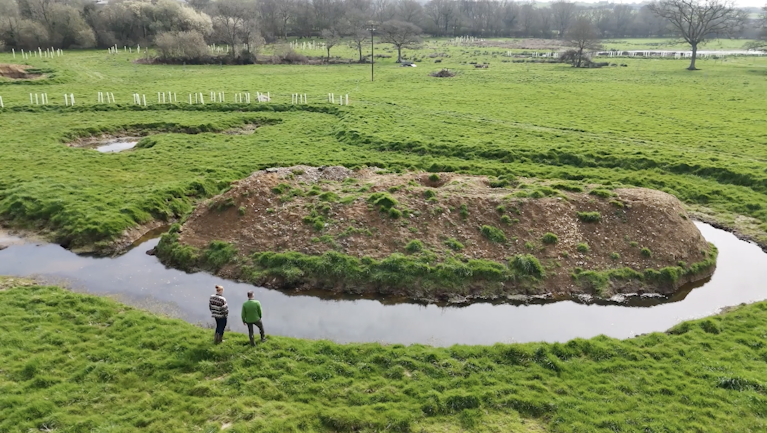
After months of planning and hard work, the transformation is beginning to show. More than 2,000 trees are now in the ground, thousands of wetland plants have been established, new ponds are settling into the landscape and perhaps most excitingly of all, wildlife is already responding.
2,000 Trees Walk Into a Field…
Across the site, a rich mix of native species has been planted to create structure, food and shelter for wildlife in the years to come.
Hazel, hawthorn, blackthorn, holly, spindle and dog rose are all beginning their journey at Downicary, carefully selected to build scrubby, wildlife-rich habitat full of blossom, berries and safe places to shelter.
For now, many of the trees sit inside guards that can make the landscape feel a little industrial, but they serve an important purpose. Young saplings are particularly vulnerable to browsing by deer and nibbling from smaller mammals such as voles. Without protection, many would simply disappear before they had the chance to establish.
Within a couple of years, the hope is that these young trees will have rooted strongly enough to outgrow their need for protection, forming dense, shrubby habitat rather than tall, sparse growth.
There's urgency here too. Spring drought remains one of the biggest risks to newly planted trees, and establishing roots while the soil is still moist could make all the difference.
Deer 0, Woodland Trust 1
One of the site's more unusual features is a specially designed "3D" electric fence, developed with advice from the Woodland Trust.
Rather than acting as a traditional barrier, the design takes advantage of the fact that deer struggle with depth perception. Multiple strands positioned at different distances make animals far less likely to jump across and browse young trees.
The aim isn't to exclude wildlife entirely, just to ease the pressure while habitats establish.
There's another clever tactic in play too: sacrificial willow. Fast-growing goat willow whips have been planted in some areas to tempt hungry deer away from more vulnerable saplings. If the willow gets eaten? That's part of the plan. It grows back quickly and helps protect slower-growing species nearby.
Getting Soggy for Science
It's not only trees going into the ground.
Across the wetter parts of the landscape, thousands of wetland plants are being introduced to increase biodiversity and create more varied habitat. Particular attention has gone into the sedge beds, with species such as greater tussock sedge and fox sedge being used to create structure in wetter grassland.
These dense tussocks will provide shelter for insects and small mammals, particularly through wet winters, while adding texture and diversity to the landscape.
Much of this work still looks young right now. But in a few years' time, these areas could become rich, layered habitats teeming with life.
Ponds: Works in Progress
New ponds are beginning to settle across the site, though not always in predictable ways.
Some water levels have dropped as the ponds adjust to local groundwater conditions, raising important questions about how water moves through the landscape. Future plans may include reshaping drainage so that water flows more naturally across the site, rather than heading straight into the river via a culvert.
Crucially, ponds don't need to remain permanently full to be valuable. Temporary pools and marshy ground, known as ephemeral wetlands, can be just as important for wildlife as permanent open water. Frogs, insects, water beetles, pond skaters and dragonflies may all benefit from these shifting, seasonal habitats as they develop. Nature recovery is rarely instant. Sometimes, success looks messy before it looks magical.
Lights, Camera, Otter!
Then came the moment everyone had been waiting for.Camera traps positioned along the riverbank had been quietly recording life at Downicary, capturing what happens when humans are nowhere to be seen.
There were familiar visitors: tawny owls perched watchfully in the darkness, roe deer moving through the site, foxes patrolling the riverbank and, yes, an astonishing number of brown rats making regular appearances.
Then came something special.
After signs of activity had been spotted along the bank, the cameras finally confirmed it: an otter. Captured in daylight, it paused beside the river before slipping into the water, an early sign that the recovering habitat is already beginning to support richer wildlife.
That wasn't all. The footage also revealed a stoat, the first confirmed record for the site, alongside herons and striking mandarin ducks gliding through the frame.
For Tay, it was confirmation that patience pays off. For Chris, it was simply "the best day on the river by far".
Just Getting Started
Downicary is still at the very beginning of its story. The trees are young, the wetlands are settling and the ponds are still finding their feet. With an otter and a stoat already on the scene, the signs are extraordinary. Who knows what might appear next?