

Dam Good News
During one of the driest summers on record, the beavers of Bowyers Wood did exactly what they evolved to do.
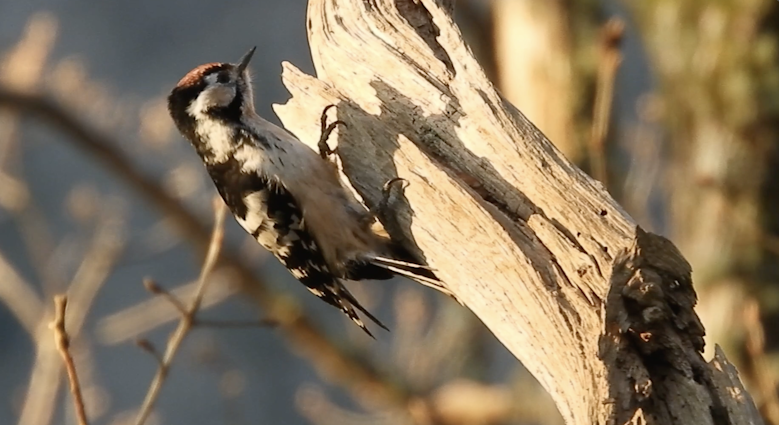
In our last update, we teased something. Dr. Ken Smith's acoustic recording devices had been quietly placed in Bowyer's Wood. Chris Packham and Mark Mallalieu of the Sussex Ornithological Society had begun scanning the treetops. The hunt for the lesser spotted woodpecker — one of England's rarest woodland birds — was officially on.
Spring has arrived since then. Primroses are pushing through the leaf litter. Peacock butterflies are tracing the sunny rides. The canopy is beginning to close.
And the recorders have been listening to all of it.
What the woodland has been whispering
The setup, if you remember, is deceptively simple. Small devices, tucked unobtrusively into the wood, capturing everything — birdsong, wind, rain, the creak of branches — around the clock. No disturbance. No human presence. Just microphones, doing what no human survey realistically can: listening continuously, for days on end.
The hard part was never collecting the sound. It was finding the signal buried inside it.
Working with specialists, thousands of recordings were examined — hours of audio reduced to spectrograms, cross-referenced against known calls and drumming patterns.
And then, buried in the data, something appeared.
They're here
Lesser spotted woodpeckers are present in Bowyer's Wood.
Not a one-off detection. Not an ambiguous snippet. Sustained, repeated activity — first the calls, then something even more significant: drumming.
Here's the thing about lesser spotted woodpeckers that makes this so exciting. They don't sing. They drum — rapid, mechanical bursts against dead wood that carry hundreds of metres through the trees. It's territorial. It's a statement. And every species does it differently. The lesser spotted woodpecker's drum is longer and more even than its larger cousin the great spotted — quieter, more measured, but unmistakable once you know the signature.
The wood had been speaking all along. Now, finally, someone was equipped to hear it.
The most maddening bird in Britain
Here's what makes this species so difficult to study — and why the acoustic approach matters so much.
Even with confirmed recordings, you can spend hours in the wood and see absolutely nothing. Lesser spotted woodpeckers live high in the canopy. They don't visit feeders. They don't show themselves at eye level. They are, in the most literal sense, above all of that.
In one monitoring session, more than two hours of recording yielded just three minutes of drumming activity.
Three minutes. That's the window. Miss it, and you'd walk away certain the wood was empty.
It's exactly this that led to the species being so drastically underestimated. Once common enough to nest in school grounds, lesser spotted woodpeckers have lost more than 80% of their population since the 1970s. They're red-listed. And because they're so hard to detect, their absence tends to be assumed rather than investigated.
Absence of evidence, as the saying goes, is not evidence of absence.
A decline with a cause
The population crash isn't random bad luck. It's a symptom of something bigger, and it matters for what happens next at Bowyer's Wood.
Climate change is quietly reshaping the timing of the natural world. Springs arrive earlier. Caterpillars — the critical food for woodpecker chicks — peak earlier too. But the birds haven't kept pace. The result is a mismatch: hungry chicks, and a food supply that's already thinning when they need it most.
In good years, aphids and other insects help fill the gap. In harder years, breeding fails.
Understanding this is part of why finding these birds matters beyond simple record-keeping. If Bowyer's Wood is going to be managed and restored in ways that give lesser spotted woodpeckers a real foothold, the team needs to know they're there first.
More widespread than we thought?
What's emerging from acoustic surveys across the country is quietly remarkable.
In Sussex, Hampshire, Derbyshire and beyond, similar recording programmes are finding lesser spotted woodpeckers in places where they hadn't been reported for years. The picture isn't necessarily as bleak as the records suggest. The birds may not have vanished from these places — they may simply have been missed, over and over, by survey methods that were never designed to find them.
Bioacoustic monitoring, combined with AI-assisted analysis, is beginning to correct that. The distribution map is being redrawn.
Could this be a breeding pair?
One bird in Bowyer's Wood would be remarkable. What the recordings suggest may be more than that.
The combination of calls and sustained drumming, over time, points to territory-holding behaviour. This isn't just a bird passing through. There's a real possibility — genuinely exciting, and worth saying carefully — that this is a breeding pair.
If so, the next challenge is to find the nest. And that, even for experts, is extraordinarily difficult. Lesser spotted woodpecker nests are hidden high in deadwood, invisible from the ground, and only really given away when chicks are old enough to start calling. Even in strongholds like the New Forest, they remain notoriously hard to pin down.
But for the first time at Bowyer's Wood, there's real reason to look.
This is what it means to really listen
There's something quietly extraordinary about all of this. A wood that's been subject to months of patient monitoring. Thousands of recordings. And hidden inside all of it, one of England's most threatened birds, going about its life in the treetops, completely unaware it's been found.
The lesser spotted woodpecker was here all along.
Bowyer's Wood is still full of secrets. But this one, at least, has finally given itself away!
Next time: we open the owl boxes. Jimmy installed them. Something may have moved in. Watch this space.