

Something's Moving In At Downicary
Under blue skies and spring sunshine, the team got together on site to see how Downicary is taking shape.
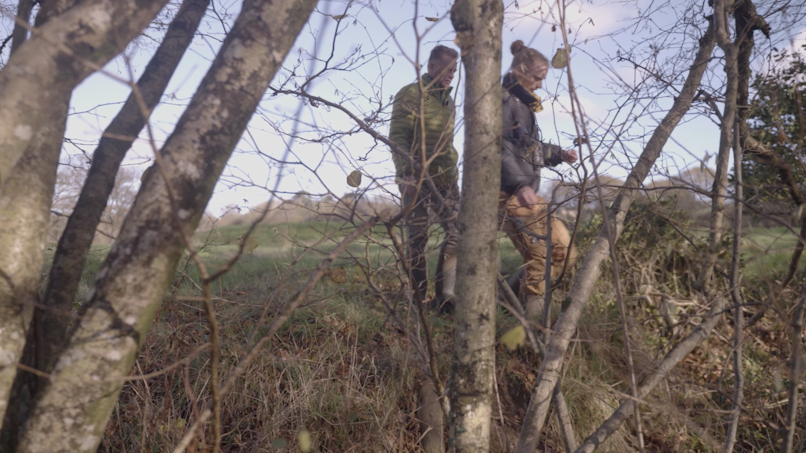
Winter sunshine can be misleading - bright skies, crisp air, thermals hidden beneath trousers. A reminder that the season is turning, even as the land quietly shifts.
At Downicary, the team meets to reflect on a year of progress. What was once a grazed, uniform field is already becoming something far more complex; wetter, rougher, richer. And, crucially, alive.
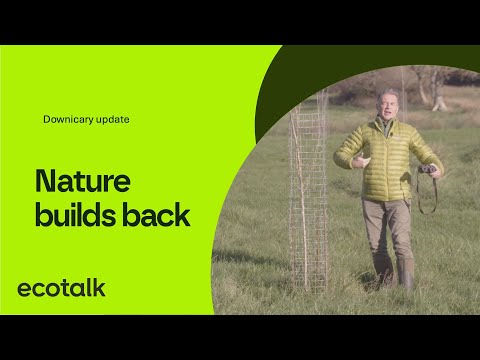
Trees with a future
The visit begins among newly planted trees. One stands out immediately; a young black poplar, a rare native species, already showing buds despite the cold. Many trees prepare for spring long before it arrives, setting their intentions quietly through winter.
Tree planting has been an important part of the work at Downicary, but it is only one piece of a much larger puzzle. What matters here is how water moves, where it settles, and how long it is allowed to stay.
Scrapes, ponds and patience
Across the wet meadow, diggers have carved a series of scrapes; shallow basins, some already holding water, others edging towards becoming small ponds. Recent rain has done its work, filling hollows and softening edges.
Grasses are beginning to establish on the banks. The rawness is fading. The land is starting to settle into its new shape.
These features are not ornamental. At night, their still surfaces act like mirrors, drawing in waders and wildfowl. Already, green sandpipers have been recorded using the islands, alongside familiar winter visitors such as mallard, teal and snipe.
The next challenge is diversity. Old pasture grasses dominate for now, but the team has begun introducing wetland plants to speed the process. Yellow flag iris, sedges and corky-fruited dropwort are going in, chosen for their ability to thrive in saturated soils and support invertebrates.
Over time, much more will arrive unaided. Seeds blown in by wind, washed down by the river, carried on feathers and fur. Rewilding rarely needs forcing; it needs time.
Letting water linger
One of the biggest questions at Downicary is how wet the site will ultimately become. For now, a culvert channels water efficiently away from the railway and straight into the river. That may change.
The team is watching carefully through winter, seeing how the scrapes respond before making further interventions. In time, slowing the flow could allow water to spill gently across the meadow, creating a true wetland rather than a field and a river running side by side.
“It stops being two things,” Chris Packham, Ecotalk’s Chief Ecologist, explains. “It becomes one system.”
Beavers already shaping the story
Down on the river, the evidence is impossible to miss. Freshly gnawed trees, pale wood exposed beneath bark, distinctive tooth marks etched into trunks. Beavers are already active, despite winter’s approach.
Camera traps tell the fuller story. Beavers of different sizes pass through frame after frame; adults, yearlings, and this year’s kits. A family group is clearly established, using the river corridor and surrounding habitat.
Unlike many mammals, beavers do not hibernate. In summer, they feed on a huge range of plants. In winter, when vegetation dies back, bark becomes the primary food source. Trees are felled not out of destruction, but necessity.
In colder parts of their range, beavers even create winter larders; sinking branches in ponds so they can be accessed beneath ice. At Downicary, the process is less extreme but no less purposeful.
A lodge sits quietly nearby, its entrances hidden beneath the waterline for protection. What appears to be a tangle of driftwood is, in fact, a carefully constructed home; insulated, secure and added to year after year.
What else is moving in?
Beavers are not the only beneficiaries.
Camera traps reveal foxes moving confidently through the site, healthy and well-furred. A polecat has been recorded crossing the bridge, a significant native predator reclaiming ground. Grey squirrels, moorhens and wood pigeons make regular appearances, alongside a steady procession of birds using the water’s edge.
Otters remain elusive, but that is no surprise. With large territories and unpredictable movements, their absence from camera traps says little. The conditions are right; they will come when they choose.
As vegetation thickens and leaf litter builds, small mammals will follow. Voles and shrews need cover; they did not thrive in the closely grazed pasture of the past. Their return would open the door to barn owls, short-eared owls and, perhaps one day, marsh harriers quartering the wetland.
From field to functioning wetland
What is striking at Downicary is how quickly change is happening once pressure is lifted. The scrapes and ponds have altered water movement almost immediately. Planting has nudged diversity forward. Beavers have accelerated everything.
Chris Packham reflects on this pace with quiet confidence. “People are often surprised by how fast landscapes respond,” he says. “Give nature water, space and time, and it gets on with it.”
This winter is not about spectacle. It is about watching, recording and adjusting. Learning where water wants to go. Seeing which species arrive first. Understanding how a field becomes a wetland.
Spring will bring growth, summer will bring noise and movement, but winter tells the truth.
At Downicary, that truth is already clear; rewilding is working.